A Lesson from Down Under for the World
30 Dec 2025 15:49:24
Twenty years from now, when the data shows improved mental health outcomes for this generation of Australian children, the world will look back and ask why it took so long. Just as we now marvel that people once drove without seatbelts or rode motorcycles without helmets. Our children deserve a childhood - real, messy, unrecorded and free.Australia has said enough is enough. Perhaps it's time the rest of the world did too.
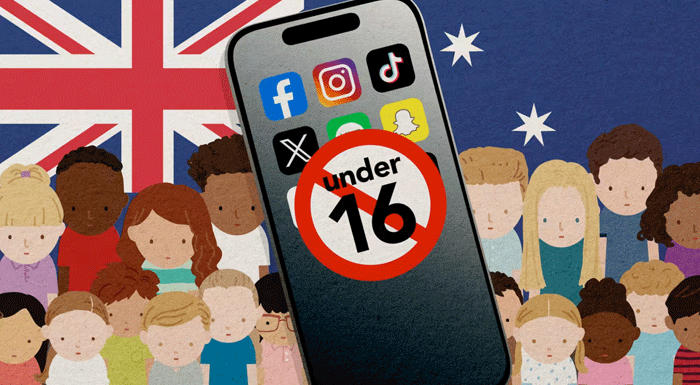
I'm watching Australia make history with a decision that many parents globally have been waiting for: a complete ban on social media for children under 16. Having lived here for two decades and raising my own children in this country, I've witnessed firsthand both the crisis and now, finally, the courage to act.
When Australia introduced mandatory seatbelt laws in the 1970s, people protested. "Government overreach!" everyone cried. “Nanny state” they said. When helmet laws for motorcyclists came in, there were demonstrations on the streets. Yet today, no Australian questions these laws. They're simply part of life - laws that save lives. The social media ban will follow the same trajectory.

@ Manali Mehta
Worked with Woolworths as the Head of Product, Design & Customer Journeys - leading UX research, Experimentation and Measurement
The Australian Crisis: Numbers That Shocked a Nation
Australia's youth mental health crisis has reached unprecedented levels. Between 2012 and 2022, emergency department presentations for self-harm among young Australians doubled. According to the Australian Institute of Health and Welfare, one in seven Australian children aged 4-17 now experience a mental health disorder.
The correlation is stark: 2012 was when smartphones and social media became ubiquitous in Australian teenagers' lives. What followed was a mental health catastrophe that has shaken this nation to its core.
A landmark 2023 study published in the Medical Journal of Australia found that Australian teenagers spending more than three hours daily on social media faced double the risk of poor mental health outcomes. Australian researchers at the University of Melbourne have documented how Instagram's algorithms specifically target young users with content designed to maximise engagement, often through comparison, anxiety, and insecurity.
Australian parents weren't asking for this ban out of technophobia. They were drowning, fighting billion-dollar tech giants alone, watching their children suffer. Many described feeling trapped between allowing social media access and watching their children's mental health deteriorate, or restricting access and seeing them become socially isolated from their peers.
The federal government's decision levelled the playing field. No parent now has to be the "bad parent" for saying no, the society has said no collectively. This removes the impossible burden from individual families who were fighting these battles alone in their homes.
What Australian Schools Have Been Seeing
Teachers across Sydney, Melbourne, and Brisbane report consistent accounts of how social media has transformed Australian classrooms, and not for the better. Cyberbullying no longer ends at the school gate. It follows students home, into their bedrooms, and continues around the clock. School counsellors report spending the majority of their time dealing with social media-related conflicts, screenshot betrayals, viral humiliation, and online harassment that devastates students' sense of safety. What once were occasional bullying incidents have become constant 24-hour crises.

Australian teachers also note that students struggle to focus on complex tasks. Their attention spans have been fractured by years of scrolling through TikTok videos and Instagram reels. The addiction is real.
The Tech Giants' Responsibility
Here's what makes Australia's approach significant: the law places the burden squarely on tech companies, not parents or children. Meta (Facebook and Instagram), TikTok, Snapchat, and other platforms must verify users' ages and prevent under-16s from accessing their services. Failure to comply brings hefty fines, up to AU$50 million.
Australia's eSafety Commissioner, Julie Inman Grant (herself a former Twitter executive), has been clear: "These companies have the world's best engineers and unlimited resources. They've used that expertise to make their platforms addictive. Now they must use it to make them safe."
The tech giants have spent millions lobbying against this law. Meta claimed it was "unworkable." TikTok said it would "isolate young people." But Australians saw through this. These are companies whose algorithms can identify a teenager's insecurities within minutes of them joining, yet they claim they can't verify age? Australians aren't buying it.
The Seatbelt - Australia’s History of Life-Saving Laws
Australia has a proud history of implementing controversial public safety laws that later became global standards. In 1970, Victoria became the first jurisdiction in the world to make seatbelts mandatory. People protested. They claimed it violated personal freedom. Some even argued seatbelts were more dangerous than going without.
Today, that seems absurd. Australian seatbelt laws have saved an estimated 200,000 lives since their introduction.
Similarly, when Australia introduced random breath testing for drunk driving in the 1980s, critics called it a police state measure. Now it's standard worldwide, having slashed Australia's road death toll dramatically.
The mandatory helmet law for cyclists and motorcyclists faced fierce resistance. Today, it's just how things are done. Head injury rates have plummeted.
Each time, Australia faced criticism. Each time, the laws were imperfect in execution. But each time, they fundamentally changed behaviour and saved lives. The social media ban will be no different.
The Critics
"It's unenforceable," critics say. Perhaps initially. But Australia's track record with seemingly unenforceable laws is strong. Random breath testing was supposed to be impossible to implement effectively, yet it works. Age verification technology is rapidly improving, and Australian tech companies are already developing robust solutions.
"It will just delay the inevitable," others argue. But three years matter enormously in adolescent development. A 16-year-old has significantly better emotional regulation, critical thinking, and self-awareness than a 13-year-old. Those three years of brain development make all the difference in handling social media's psychological pressures.
"Digital literacy education is the answer," some suggest. Australia tried that. It failed. You cannot educate children to resist platforms designed by the world's best behavioural psychologists specifically to override rational decision-making. As Australian neuroscientists have noted, teaching kids to use social media responsibly is like teaching them to responsibly use cigarettes.
The Tech Companies Must Step Up
Australian Prime Minister Anthony Albanese was blunt when announcing the ban: "Social media is doing harm to our kids and I'm calling time on it."
But legislation alone isn't enough. The real responsibility lies with Meta, TikTok, Snapchat, YouTube, and other platforms. These companies must:
* Implement robust age verification that actually works
* Redesign algorithms to stop targeting vulnerabilities
* Remove harmful content proactively, not reactively
* Make platforms genuinely safe, not just legally compliant
* Put child wellbeing above engagement metrics and profit
They have the technology. They have the resources. What they've lacked is the will, until now, when governments are forcing their hand.
Mental Health Crisis
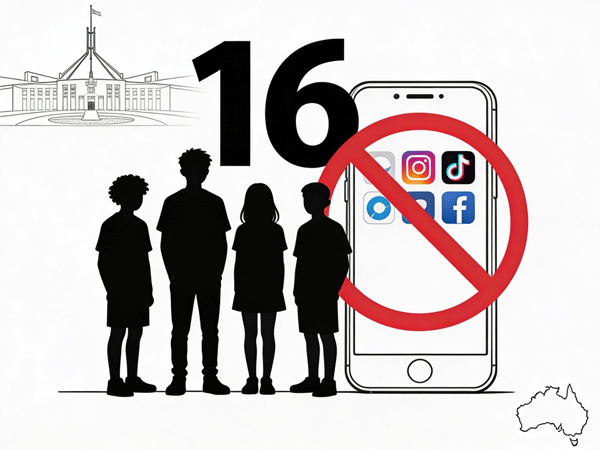
Reports from Australian youth mental health services paint a concerning picture. Headspace, Australia's national youth mental health foundation, has documented sharp increases in young people seeking help for anxiety, depression, and self-harm, much of it linked to social media use.
Beyond Headspace, counsellors note that young Australians are presenting with issues that barely existed a generation ago: fear of missing out (FOMO), constant comparison anxiety, and distress over their online personas. The pressure to maintain a curated digital presence while still figuring out their real identity has proven overwhelming for many.
A Childhood Worth Protecting
Australia's message to the tech giants is simple: childhood is a distinct phase of life that deserves protection, not exploitation. Children have the right to grow up without performing for an audience, without constant comparison to impossible standards, without managing their digital reputation before they've figured out who they are.
Twenty years from now, when the data shows improved mental health outcomes for this generation of Australian children, the world will look back and ask why it took so long. Just as we now marvel that people once drove without seatbelts or rode motorcycles without helmets.
The tech giants will adapt because they must. Other countries will follow because the evidence will be undeniable.
Our children deserve better than to be data points in Silicon Valley's growth metrics. They deserve a childhood - real, messy, unrecorded and free. Australia has said enough is enough. Perhaps it's time the rest of the world did too.
- Manali Mehta
Manali.s.mehta@gmail.com